
Entrepreneurs often succeed because they are prepared to commit extraordinary amounts of time, money and energy to their businesses. But there is a point where commitment becomes overcommitment and where determination begins to threaten physical health, mental wellbeing and personal relationships.
The answer is not simply to work fewer hours. Business owners need to recognise that their own health is part of the critical infrastructure of the business. Like putting on an oxygen mask before helping somebody else, protecting yourself is necessary if you are to continue supporting the organisation.
The longer-term solution is to reduce the business's dependency on its owner through better systems, documented processes, delegation, automation and stronger management capability. Exceptional effort may sometimes be necessary, but it should never become the permanent operating model. A resilient business should ultimately be capable of supporting its owner rather than continually consuming them.
There is no doubt that setting up and running a business requires commitment.
Commitment of time, money, mental energy and physical effort. Time and again, in my own experience and while working with clients and business associates, I have seen promising ideas fail because the full range of commitment simply was not there.
I often talk about the difference between willpower and want power.
Willpower is the force you apply to make yourself do something. Want power is different. It comes from wanting an outcome so strongly that you are prepared to endure the difficult journey required to achieve it.
Entrepreneurs frequently need both.
In the early stages of a business, money is usually finite and its limits are fairly obvious. When money is unavailable, however, the shortfall is often filled with the founder's own time.
Anything to get the job done.
A task that could be outsourced is done in the evening. Administration moves into the weekend. Holidays disappear. An important customer issue is dealt with at 10 o'clock at night because nobody else can deal with it.
Initially, want power drives the process. The excitement of building something new provides enormous energy.
Eventually, though, the mind and body start to resist. At this point willpower takes over.
And this is where commitment can become dangerous.
When commitment becomes overcommitment
Sometimes there are natural constraints.
A partner may insist that work stops at a reasonable time. Children create responsibilities that cannot easily be ignored. Friends, family or colleagues may provide an external reminder that there is life outside the business.
But sometimes those constraints are absent.
Worse, the desire to succeed can become so overwhelming that relationships and personal wellbeing are deliberately pushed to one side. This can easily be rationalised as temporary.
"I'll just get through the next few months."
"Things will calm down once this project is finished."
"I'll take some time off when we reach the next milestone."
The difficulty is that the next milestone is usually followed by another one.
Months can become years.
Entrepreneurs are, almost by definition, prepared to do things that other people may regard as unreasonable. They take risks, tolerate uncertainty and sometimes become almost monomaniacal about achieving an objective.
That intensity can be enormously valuable.
But it also has limits.
The question is not whether commitment is necessary. It clearly is.
The much more difficult question is: where should the line be drawn before the physical or mental limit is reached?
By physical limit I mean exactly that: the point at which the mind or body simply refuses to continue.
Exhaustion. Burnout. Serious illness. A heart problem. An infection that becomes much worse because somebody has been running on empty for months.
I have seen all of these.
On several occasions I have warned business owners that their lives appeared dangerously out of balance, only for them to become seriously ill shortly afterwards.
There is nothing mysterious about this. It is simply observation.
Eventually the warning lights become visible.
Put your own oxygen mask on first
Nobody leaves a steady nine-to-five job because their ambition is to work an 80-hour week, damage their family life and lose contact with their friends.
Yet business ownership can gradually produce exactly that outcome.
So what can be done?
The answer starts with a change in mindset.
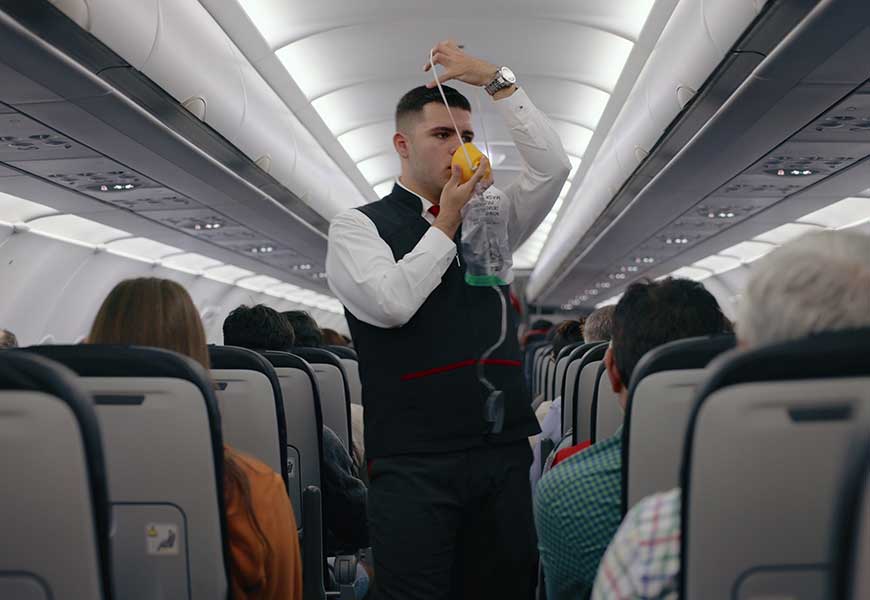
Anyone who has flown regularly will recognise the safety instruction given before take-off. If oxygen masks are required and you are travelling with somebody vulnerable, you are told to put your own mask on first.
Imagine travelling with your child.
Your instinct may be to help them immediately. Yet the instruction is to secure your own oxygen supply before helping them.
Why?
Because if you become incapacitated, you cannot help anybody.
The same principle applies to running a business.
Your physical and mental health are not separate from the business. They are part of its critical infrastructure.
If the company depends heavily upon you, protecting your health is therefore not an indulgence. It is risk management.
Put the oxygen mask on yourself first.
Then ask another question.
What does the business need so that it becomes less dependent upon your oxygen supply?
Make the business less dependent on you
The long-term solution to entrepreneurial overwork is rarely simply "work fewer hours".
If the underlying business still requires 70 hours of your attention, deciding to work 40 merely creates another problem.
The business itself has to change.
Start by identifying work that can be **systemised**. Repeated activities should gradually become processes rather than something that exists entirely inside the owner's head.
Write procedures. Create templates. Automate routine tasks. Introduce software where it genuinely saves time.
Then look at delegation.
Owners often retain tasks because they can do them faster or better than somebody else. This may be true, but it can also become a trap.
A task completed by somebody else at 90% of your standard may be far more valuable than a task performed perfectly by you if it releases several hours every week.
Look too at the structure of the organisation.
Who could make decisions if you were unavailable tomorrow?
Who understands the customers?
Who understands the finances?
Where are passwords, contracts, supplier information and critical procedures stored?
A useful test is to ask:
"What would happen if I disappeared from the business for four weeks?"
The answer reveals a great deal about both business resilience and personal risk.
Create limits before you reach them
There is also a more personal discipline required.
Do not wait until exhaustion tells you where your limit is.
Set some boundaries deliberately.
Protect sleep. Maintain some physical activity. Take proper breaks. Keep some interests and relationships that have nothing to do with the business.
Watch for changes in yourself: persistent tiredness, irritability, poor concentration, difficulty sleeping, increasing alcohol consumption, withdrawing from people or constantly feeling that you cannot stop working.
And create external accountability.
A partner, colleague, coach, adviser or trusted friend may recognise deterioration long before you do.
Business owners are particularly poor at diagnosing their own overcommitment because the behaviour causing the problem often feels like dedication.
Commitment must be sustainable
Building a business sometimes requires extraordinary effort.
There may genuinely be periods when evenings disappear, weekends are sacrificed and everything else temporarily takes second place.
The mistake is allowing exceptional effort to become the permanent operating model.
A business that can only survive through the continuing physical sacrifice of its owner is not yet a resilient business.
The objective should therefore change over time.
At the beginning, the owner supports the business.
Later, the challenge is to build a business capable of supporting the owner.
That means people, systems, processes, delegation and sufficient resilience that the company does not depend upon one person's continual presence.
Commitment remains essential.
But sustainable commitment requires something more sophisticated than simply pushing harder.
It requires knowing when to use want power, when to use willpower — and when to stop relying on either.
Because sometimes the most important thing you can do for your business is to put your own oxygen mask on first.